The industrial port
-
Active service
Port Services
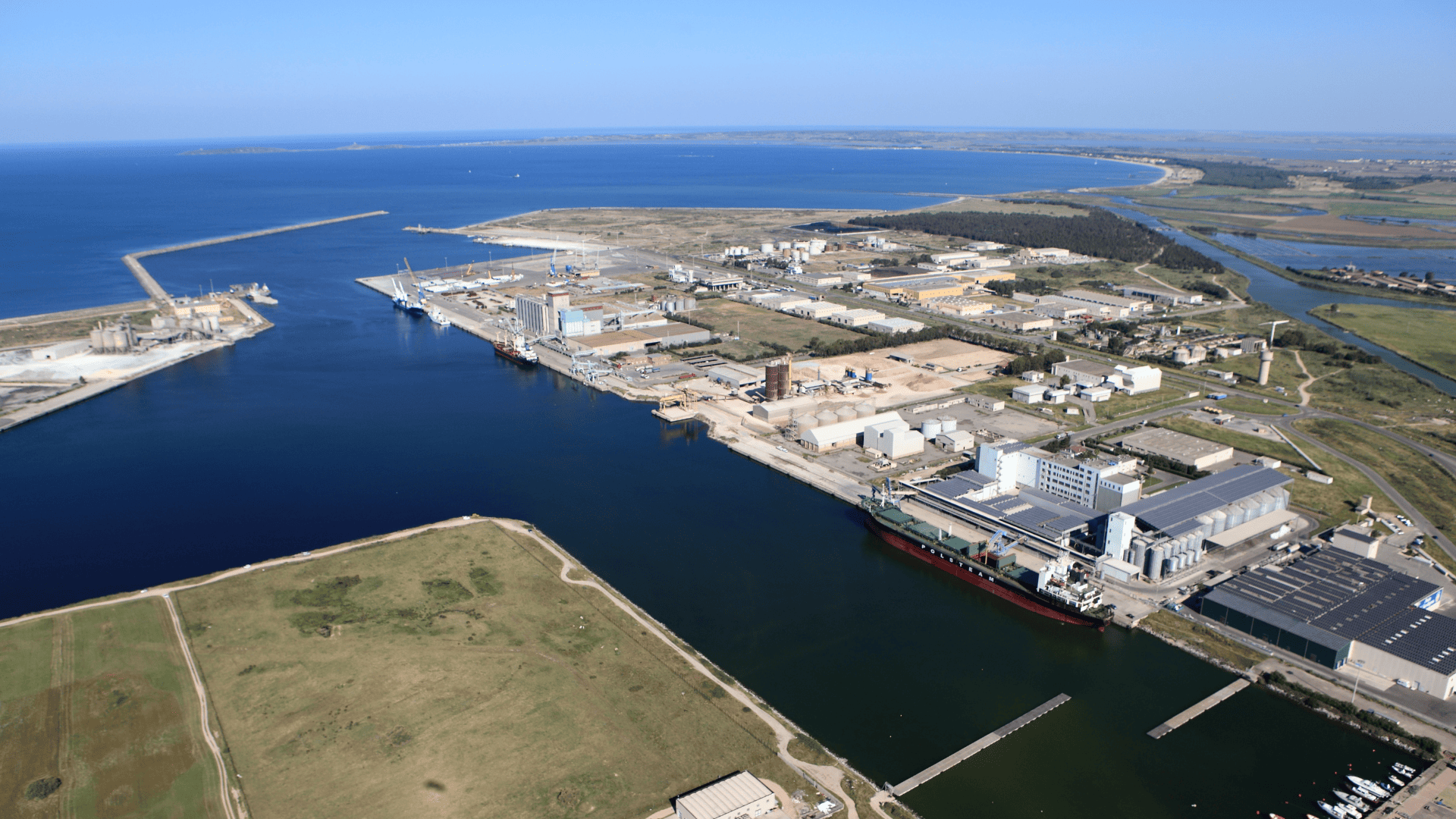
The industrial port of Oristano stands out for its strategic geographical position and highly favorable operating conditions, representing a unique opportunity compared to other national port facilities.
A Port of National Importance
Thanks to its size and key role, the port is recognized as a “port of national relevance” under Art. 36, paragraph 5, of Law No. 166 of 01/08/2002, falling within Category II, Class II. Located in the heart of Sardinia’s western coast, in the Gulf of Oristano, the port is integrated into the province’s industrial area, offering privileged access to international markets.
A Strategic Infrastructure for Global Trade
Its position on the Suez–Gibraltar route, crucial for international trade, provides a competitive advantage. Moreover, the shape of the Gulf of Oristano offers natural protection for port operations. The navigable channel, with seabeds of -11 meters, allows large-tonnage vessels to dock, ensuring efficient and competitive logistics.
A Versatile Port: Commercial and Industrial
The Port of Oristano serves a dual function:
- A modern commercial port equipped with advanced services and wide areas dedicated to cargo handling.
- Porto industriale, ideale per le imprese situate lungo il canale navigabile, che possono effettuare operazioni di carico e scarico con autonomia funzionale.
This feature, unique at the national level, enables companies to purchase areas facing the channel and build private facilities with exclusive-use docking terminals.
Customs Advantages and Operating Infrastructure
Another strong advantage is the possibility of operating as a private customs warehouse, benefiting from a favorable tax regime similar to that of customs free zones.
Operational since 1975, the port works 365 days a year, situated between the sea and the Santa Giusta lagoon. It offers over 20 hectares of equipped yards and approximately 1,600 meters of quays, ensuring logistical and operational efficiency.
Specialization in Bulk Cargo Handling
For over 20 years, the port has been a reference point for handling bulk goods, including minerals, organic and chemical products, hydrocarbons, steel semifinished products, and machinery. Handling these goods, although considered low-yield, is highly competitive thanks to dedicated spaces, competitive costs, and the absence of interference with passenger traffic.
This specialization has contributed to the growth of local operators, developing advanced technical and operational skills, including the ability to handle containers from feeder vessels calling at the port.
The Port of Oristano: a strategic hub for industrial development
The Provincial Industrial Consortium of Oristano, as a territorial and infrastructural development authority, continues to support and enhance the role of the Port of Oristano as a fundamental logistics platform for the economy of the territory and Sardinia.
Shipping traffic in continuous operation
In the 2022–2024 three-year period, the Port of Oristano handled:
- 535 ships in 2022
- 473 ships in 2023
- 416 ships in 2024
Despite a slight decrease in maritime traffic, the port maintained significant operational continuity, confirming its role as a crucial node in national and EU maritime transport.
Cargo handling: a diversified logistics platform
In 2024, cargo traffic recorded a total volume of 1,312,491
- 930,630 tons of unloaded goods
- 381,861 tons of loaded goods
These figures demonstrate a complex logistics dynamic involving strategic products for various production sectors.
Unloaded goods (2024)
Main commodity categories include:
- Animal feed (42.89%): corn, soy, oats, barley, fava beans, and by-products
- Human food (21.23%): durum wheat and soft wheat
- Materials for energy and industrial production: pellets, vegetable oils, LNG, diesel
- Raw materials for cement production (15.37%): clinker, petcoke, bauxite, iron silicate
- Fertilizers and bitumen
- Industrial equipment: wind turbines, towers, other mechanical components
Loaded goods (2024)
Outbound goods consist exclusively of raw materials extracted locally, such as:
- Feldspar (82.06%)
- Perlite (11.16%)
- Bentonite, kaolin, and iron silicate
These materials confirm the importance of the Oristano mining district and the role of the port as a logistics terminal for local resources.
Infrastructure supporting development
The Industrial Consortium works to strengthen and modernize logistics and production infrastructures, promoting the establishment of new businesses and supporting ecological transition, digitalization, and industrial process innovation.
The Port of Oristano thus reaffirms its position as a strategic node in the regional production system, a driver of sustainable growth, and an attractor of future investments.
Port characteristics
| DESCRIPTION | TECHNICAL DATA |
| Outer breakwater (windward) | length: 1,610 m |
| Outer breakwater (leeward) | length: 700 m |
| Outer access channel | depth: -13.50 m |
| Outer harbor | depth: -12.00 m |
| Navigable penetration channel West–East: | total length: 1,580 m depth: -12.00 m / -9.50 m usable width at the bottom: 160 m |
| South navigable channel: | total length: 480 m
depth: -11 m usable width at the bottom: 160 m |
| Turning basin: | diameter: 450 m
depth: -11.00 m |
| Quays at the leeward pier | length: 306 m |
| Common-use port yard quays | total length: 920 m |
| Quays serving industrial facilities | total length: 1300 m |
| Equipped port yard area | Surface: 20 ha |
| Equipped container storage area | Surface: 4.4 ha |
| Equipped refrigerated container storage area | Surface: 0.6 ha |
| Ferry docking ramps | No.: 2 |
| Potable water distribution network | Length: 2680 m
No. of ship supply hydrants: 24 |
| Firefighting network | Length: 3750 m
No. of column hydrants: 19 No. of underground hydrants: 31 |
| Blackwater collection network (buildings) | Length: 520 m |
| Stormwater and drainage collection network | Length: 4100 m |
